Spray Foam Roofing for Flat Roofs | Wannamaker
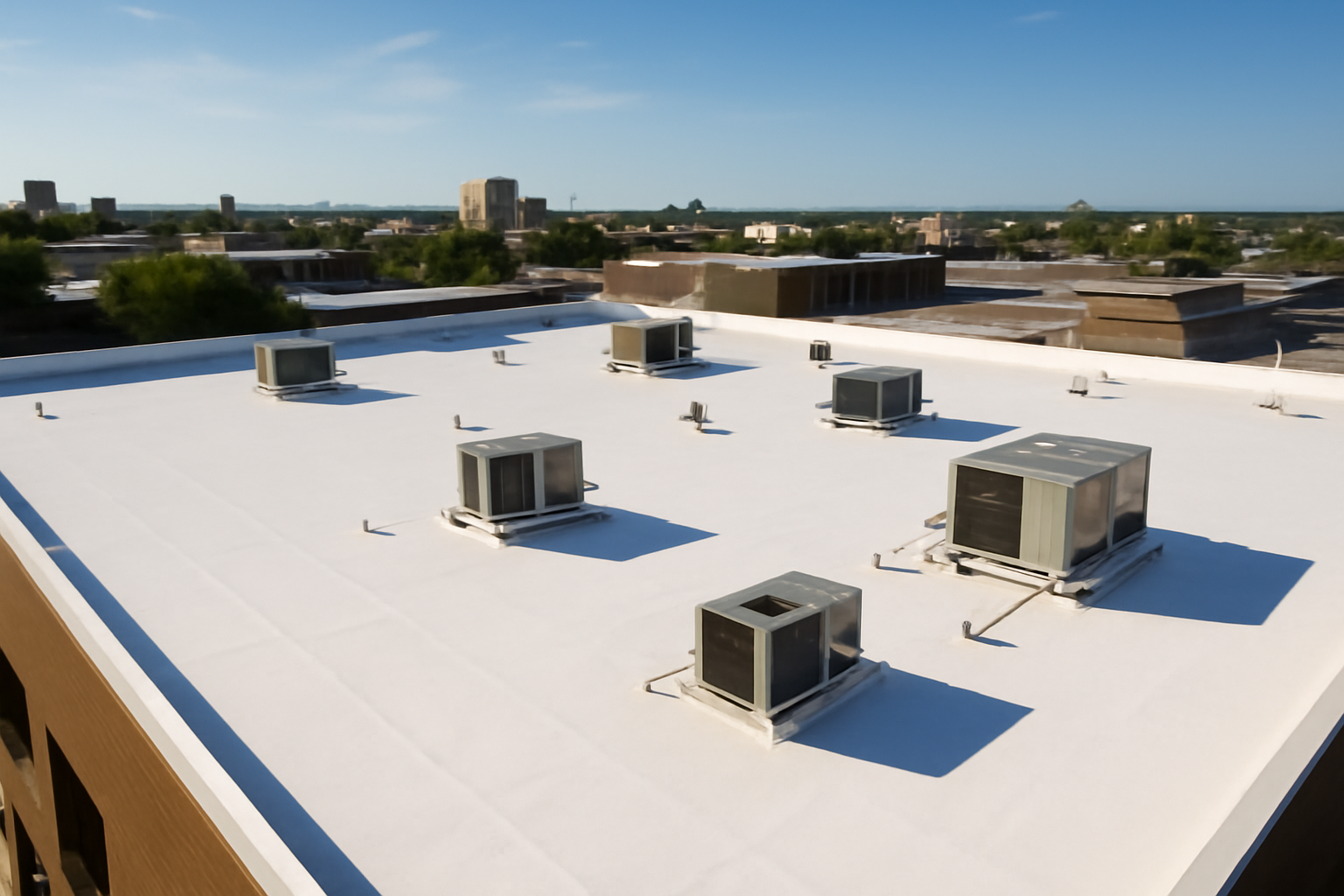
If you own a flat-roofed commercial building in San Antonio — a strip center, a warehouse, a church, an office — you've probably had someone pitch you on spray foam roofing. The promises sound almost too good: seamless coverage, R-value insulation built in, a roof that can be recoated instead of replaced. Some of those promises are true. Some come with serious caveats that salespeople conveniently skip. Let's get into the details so you can make a decision based on reality, not a brochure.
What Spray Foam Roofing Actually Is
Spray polyurethane foam (SPF) roofing is a two-component liquid system — an isocyanate and a polyol resin — that's sprayed directly onto an existing roof substrate. When the chemicals meet at the spray gun tip, they react and expand into a rigid, closed-cell foam. Within seconds, you've got a monolithic layer of insulation and waterproofing bonded directly to the roof deck.
The foam itself isn't UV-stable, so every SPF roof requires a protective top coat. Most commercial applications use either a silicone or acrylic elastomeric coating, usually applied in two passes to reach 20-30 mils of dry film thickness. The coating is what gives the roof its characteristic white, reflective surface — and it's also the part that needs maintenance down the road.
Why SPF Works Well on San Antonio Flat Roofs
San Antonio's climate creates specific problems for flat roofing systems: brutal UV exposure, thermal cycling that can exceed 60°F in a single day during spring, and hailstorms that roll through the I-35 corridor every season. SPF addresses several of these issues simultaneously.
- Seamless membrane. No seams means no seam failures. On a traditional built-up or single-ply roof, seams are the number-one failure point. SPF eliminates them entirely — it wraps around penetrations, parapets, and HVAC curbs in one continuous layer.
- Built-in insulation. Closed-cell SPF delivers roughly R-6.5 per inch. A 1.5-inch application gives you nearly R-10 of insulation that didn't exist before — directly reducing cooling costs in a city where commercial HVAC runs 8+ months per year.
- Reflectivity. The white elastomeric top coat reflects a significant percentage of solar radiation. On a dark EPDM or modified bitumen roof, surface temperatures can hit 170°F in July. A properly coated SPF roof might stay below 110°F under the same conditions.
- Self-flashing capability. Foam conforms to any shape. Pipes, vents, scuppers, and drains get encapsulated rather than requiring separate flashing details — fewer components, fewer potential leak points.
- Renewable lifespan. Instead of tearing off and replacing the entire roof every 15-20 years, an SPF system can be recoated. A well-maintained SPF roof can last 30-50 years with periodic recoats every 10-15 years.
The Honest Downsides
Here's where the sales pitch usually stops and reality begins. SPF roofing has real limitations, and ignoring them leads to expensive problems.
- Installation is unforgiving. Temperature, humidity, wind speed, and substrate moisture all have to be within spec during application. In San Antonio, high humidity mornings and sudden afternoon storms can shut down a spray day with no warning. A contractor who sprays in marginal conditions will deliver a roof that blisters, delaminates, or fails within a few years.
- Hail vulnerability. SPF is softer than TPO, PVC, or metal. Large hail — and San Antonio regularly sees 1-2 inch stones — can puncture the coating and gouge the foam. The damage is repairable, but it needs to be addressed quickly before moisture infiltrates the open cells at the impact site. If you're in a high-hail zone like Schertz or New Braunfels, this is a real consideration. We handle hail damage repair on all roof types, including SPF.
- Foot traffic damage. If your roof has HVAC units that need regular service, technicians walking on SPF can dent and damage the coating. Walk pads are essential but add cost.
- Not every substrate qualifies. Wet or deteriorated decking underneath can't just be foamed over. A thorough roof inspection with moisture scanning is mandatory before committing to SPF. Skipping this step is the single biggest mistake building owners make.
- Limited contractor pool. SPF requires specialized spray rigs, trained applicators, and manufacturer certifications. The barrier to entry is higher than for shingle or single-ply installation, which means fewer qualified contractors — and more unqualified ones trying to break in.
What SPF Roofing Costs in San Antonio
Pricing for spray foam roofing on a commercial flat roof in the San Antonio market typically runs $4.50 to $8.00 per square foot installed, depending on foam thickness, coating system, substrate prep, and building access. A 10,000 square foot warehouse roof might land between $45,000 and $80,000.
That's comparable to — and sometimes higher than — a quality TPO or PVC single-ply system. The cost advantage of SPF shows up over time: recoating at year 12-15 typically costs $1.50 to $3.00 per square foot, far less than a full tear-off and replacement. Over a 30-year window, SPF often comes out ahead on total cost of ownership. For a full breakdown of how different systems compare, check our guide to roof replacement cost in the San Antonio area.
SPF vs. Other Flat Roof Systems
SPF vs. TPO/PVC Single-Ply
Single-ply membranes are the workhorse of commercial flat roofing in Texas. They're tough, hail-resistant, and well-understood. TPO and PVC handle foot traffic better than SPF and are less weather-sensitive during installation. But they have seams, they don't add insulation, and they eventually need full replacement. If your existing roof is in decent shape and you want to avoid tear-off, SPF has the edge. If you're starting from a bare deck, single-ply is often simpler and more predictable.
SPF vs. Modified Bitumen
Mod-bit is proven, affordable, and handles hail well. But it's dark (absorbs heat), offers no insulation value, and requires torch or hot-mop application — a fire risk on an occupied building. SPF is the better long-term investment for building owners focused on energy savings.
SPF vs. Metal
Low-slope metal roofing (standing seam or R-panel) is durable and long-lasting but significantly more expensive on large commercial buildings. Interestingly, SPF is sometimes applied over existing metal roofs to seal leaking seams and add insulation — a retrofit approach that can buy another 20 years without the cost of a full metal replacement.
What to Look for in an SPF Contractor
This is where we get blunt: spray foam roofing is only as good as the crew applying it. A mediocre shingle job might last 15 years instead of 20. A mediocre SPF job can fail in 3 years. Here's what to verify:
- Manufacturer certification. The contractor should be certified by the foam and coating manufacturer to install their system. This is what triggers the manufacturer's warranty.
- Moisture survey before application. Any contractor who quotes SPF without performing an infrared or nuclear moisture scan of your existing roof is cutting a critical corner.
- Weather protocol. Ask what their temperature and humidity cutoffs are. If they don't have specific numbers, walk away.
- Local track record. SPF applied in Phoenix performs differently than SPF applied in San Antonio. You want a contractor who understands our humidity, our hail exposure, and our building codes. Our commercial roofing team works across the San Antonio metro and surrounding Hill Country communities.
Not Sure If SPF Is Right for Your Building?
The only way to know is to get on the roof and assess what's there. We offer a free roof inspection for commercial buildings across San Antonio, Stone Oak, Helotes, and surrounding areas. We'll evaluate your existing system, check for trapped moisture, and give you an honest recommendation — even if that recommendation is a different roofing system. No pressure, no obligation.
Bottom Line
Spray foam roofing is a genuinely excellent system for the right building and the right conditions. It's not a miracle product, and it's not the cheapest option upfront. But for flat commercial roofs in San Antonio where energy costs are a concern, the existing substrate is sound, and the owner plans to hold the property long-term, SPF delivers a combination of performance, insulation, and renewability that's hard to beat. The catch is that it demands a skilled contractor and a commitment to periodic maintenance. Skip either one, and you'll wish you'd gone with TPO.