Gutter Guards That Survive Oak Debris | Wannamaker
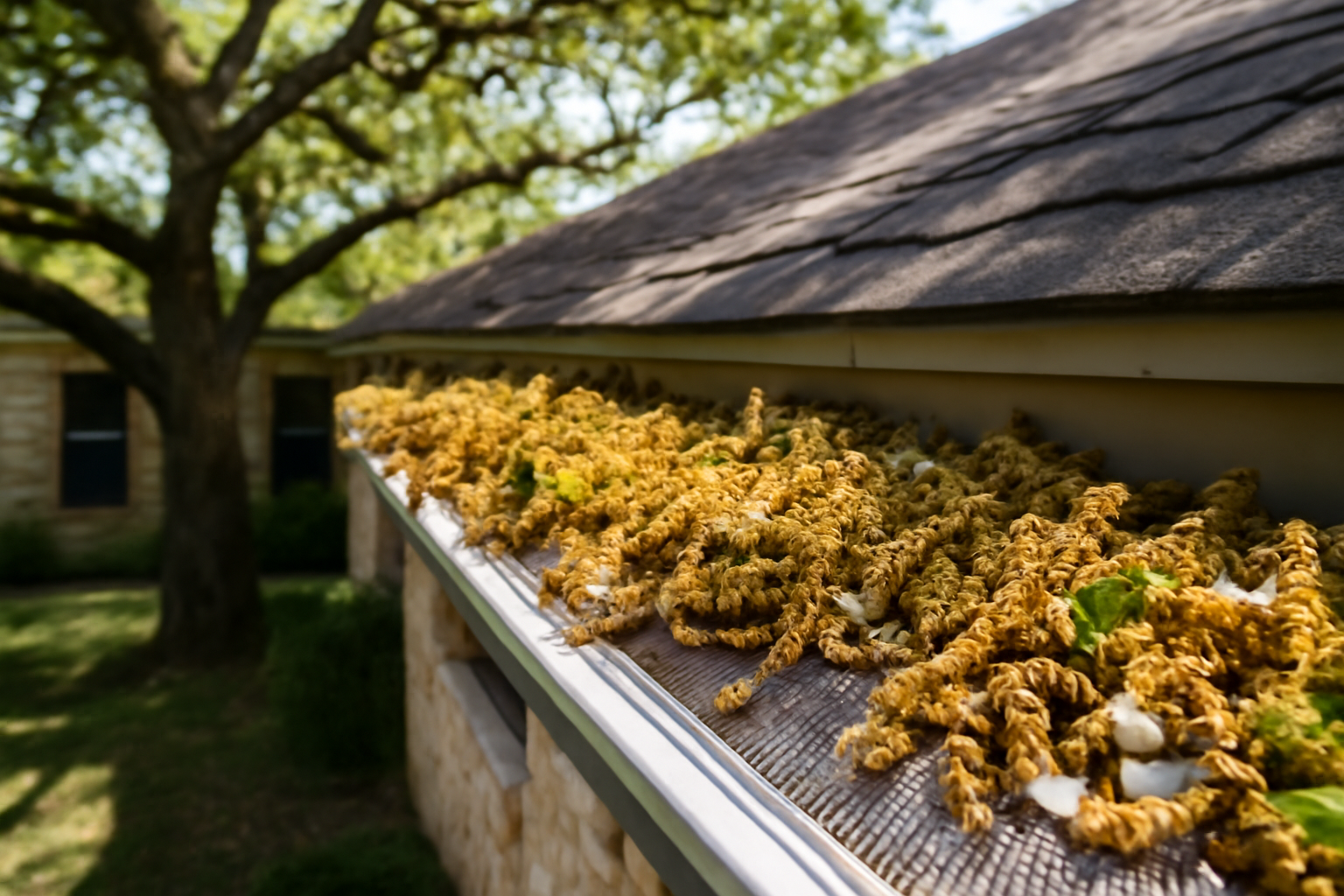
If you live in Alamo Heights, Olmos Park, Terrell Hills, or anywhere with mature live oaks, you already know the drill: gutters clogged with catkins in March, acorns in fall, and a slow drizzle of tiny leaves the rest of the year. Live oaks are technically evergreen, which means they never fully stop shedding. That makes gutter protection both more important and harder to get right than in cities with deciduous-only trees. We've seen every type of gutter guard fail in San Antonio — and a few that actually work. Here's what we've learned pulling debris off roofs since 2012.
Why Oak Debris Is Harder Than "Normal" Leaves
Most gutter guard manufacturers test with maple leaves — big, flat, easy to shed. Live oak debris is a different animal entirely:
- Catkins. Those fuzzy, pollen-heavy strands that coat everything in spring are 2-4 inches long and thin enough to slip through large-hole screens. Once wet, they form a dense mat that blocks water flow even on top of a guard.
- Small, stiff leaves. Live oak leaves are roughly 1-2 inches long and don't curl flat like maple leaves. They stand on edge, wedge into slots, and resist wind removal.
- Pollen and tannin residue. Even after leaves blow off, a sticky film remains that traps fine particles over time, gradually reducing flow through mesh openings.
- Year-round shedding. There's no single "leaf season." Guards need to perform 12 months a year, not just October through December.
The Five Main Types — Ranked for Oak Country
1. Micro-Mesh (Best Overall for Oaks)
Micro-mesh guards use a fine stainless steel screen — typically 50 to 100+ openings per square inch — mounted on an aluminum frame. This is the only type we consistently see performing well under live oaks after 3-5 years. Catkins sit on top and dry out; wind or a quick brush removes them. Water flows through the mesh even during heavy Hill Country downpours. Brands like LeafFilter, HomeCraft, and Raptor are common in the San Antonio market. Expect to pay roughly $15-$30 per linear foot installed, depending on roof pitch and accessibility. That's not cheap, but it's the price of actually solving the problem.
The catch: micro-mesh still needs occasional maintenance. Tannin buildup can reduce flow after a few years, and a gentle cleaning with a garden hose from the ground fixes it. Anyone who tells you "never clean your gutters again" is selling you a fantasy.
2. Reverse-Curve / Surface Tension (Mixed Results)
These are the solid-top guards with a curved lip that uses surface tension to pull water into a narrow slot while debris slides off the edge. Brands like LeafGuard and Gutter Helmet fall here. They work reasonably well with large leaves. The problem under oaks is twofold: catkins wrap around the curve and wick into the slot, and small leaves wedge into the gap. We've removed reverse-curve systems from homes in Stone Oak and Helotes where the homeowner was getting overflow during moderate rain because the slot was packed with debris. Pricing is similar to micro-mesh ($18-$30/ft installed), so you're paying premium prices for middling performance under oaks.
3. Perforated Aluminum Covers (Decent Budget Option)
Solid aluminum panels with small punched holes. Less expensive than micro-mesh (roughly $8-$15/ft installed) and better than screens. They block most leaves and acorns, but catkins can lodge in the perforations. If you're on a budget and willing to do a seasonal cleaning, perforated covers are a reasonable compromise. They're also sturdy enough to handle the occasional pecan or oak branch without denting.
4. Foam Inserts (Avoid Under Oaks)
Foam wedges that sit inside the gutter and let water filter through while blocking debris. In theory. In practice, fine oak debris embeds in the foam, seeds sprout in it, and within two years you have a soggy, decomposing sponge that's harder to clean than an open gutter. We've pulled foam inserts out of homes in Alamo Heights that were literally growing grass. Hard pass.
5. Basic Screens and Snap-In Plastic Guards (Worst for Oaks)
The $1-$3/ft products from big-box stores. Large openings let catkins and small leaves right through. Plastic warps in San Antonio's UV exposure within a couple of seasons. Metal screens sag and pull away from the gutter lip. These create a false sense of security — homeowners stop checking their gutters, debris accumulates underneath the screen, and by the time they notice water pouring over the fascia, there's often roof repair damage at the eave line.
How Clogged Gutters Damage Your Roof
This is the part most gutter guard companies skip. Backed-up gutters don't just cause foundation issues (though they absolutely do). Water pooling behind a clogged gutter saturates the fascia board, wicks up under the drip edge, and rots the decking at the roof's edge. We see this regularly during free roof inspections — soft spots along the eaves that started as a gutter problem. On asphalt shingle roofs, the bottom row of shingles lifts and curls when the starter strip stays wet. On tile roofing, the underlayment degrades faster at the eave. Either way, a $200 gutter cleaning you skipped can turn into a $2,000 eave repair.
Our Recommendation for San Antonio Homeowners
If you have significant oak canopy over your roof, invest in micro-mesh guards and budget for a light cleaning once or twice a year. If you're on a tighter budget, perforated aluminum covers plus a twice-yearly gutter check is a solid Plan B. Skip foam inserts entirely, and don't expect big-box screens to hold up past one catkin season.
When choosing an installer, ask whether they secure the guard under the first row of shingles or attach it to the gutter lip only. Under-shingle mounting is more secure but can void some shingle warranties if done improperly. A good installer knows the difference and will tell you upfront. Also confirm they're using stainless steel mesh, not aluminum mesh — aluminum corrodes faster in our climate, especially with tannin-heavy oak runoff.
Worried About Eave Damage From Backed-Up Gutters?
Clogged gutters are one of the most common sources of hidden roof damage we find. If it's been a while since anyone looked at your eaves and fascia, schedule a free roof inspection with Wannamaker Roofing. We'll check for soft decking, water staining, and drip edge issues — no sales pitch required. Just honest answers about what your roof actually needs.
Quick Comparison Table
Here's the bottom line for each guard type under live oak canopy:
- Micro-mesh. Best catkin defense, excellent water flow, $15-$30/ft, needs occasional rinse. Our top pick.
- Reverse-curve. Good for large leaves, poor for catkins and small oak leaves, $18-$30/ft. Overpriced for oak-heavy lots.
- Perforated aluminum. Solid budget option, $8-$15/ft, requires seasonal maintenance.
- Foam inserts. Grows plants. Avoid.
- Basic screens/plastic. UV-degraded within two years, lets catkins through. Worse than nothing because it hides problems.
No gutter guard eliminates maintenance entirely. But the right one — properly installed — turns a dangerous ladder climb every few weeks into a quick ground-level hose-off twice a year. That's a trade worth making, especially if your roof and fascia are in good shape and you want to keep them that way.