Code Upgrade Coverage on Texas Roof Claims | Wannamaker
Here's a scenario we see almost every hail season: a homeowner files a claim, gets an approved estimate, and then finds out mid-project that their roof deck needs new fastener patterns, thicker underlayment, or upgraded ventilation to meet current City of San Antonio building codes. The original insurance estimate didn't account for any of that. Now they're staring at $2,000–$5,000 in unexpected costs. The fix? A line item on their policy they never knew about — code upgrade coverage (sometimes called "Ordinance or Law" coverage).
What Is Code Upgrade Coverage?
Code upgrade coverage — formally known as Ordinance or Law coverage — is an endorsement or built-in provision on your homeowner's insurance policy. It pays the additional cost of bringing your damaged property up to current building codes when a covered loss triggers a repair or replacement.
Without it, your policy only pays to restore your roof to its pre-loss condition. That sounds reasonable until you realize your roof was built under 2005 codes (or older), and the City of San Antonio now enforces the 2021 International Residential Code with Texas amendments. The gap between old and new requirements isn't trivial.
Why This Matters in San Antonio Specifically
Texas building codes have changed significantly over the past 15 years, especially around wind resistance, underlayment requirements, and roof deck attachment. San Antonio adopted updated versions of the IRC that include stricter nailing schedules for decking, requirements for ice-and-water shield or synthetic underlayment in certain applications, and enhanced ventilation standards.
If your home was built before roughly 2012, there's a good chance your roof doesn't meet current code in at least one area. Common upgrades we encounter during insurance claim projects include:
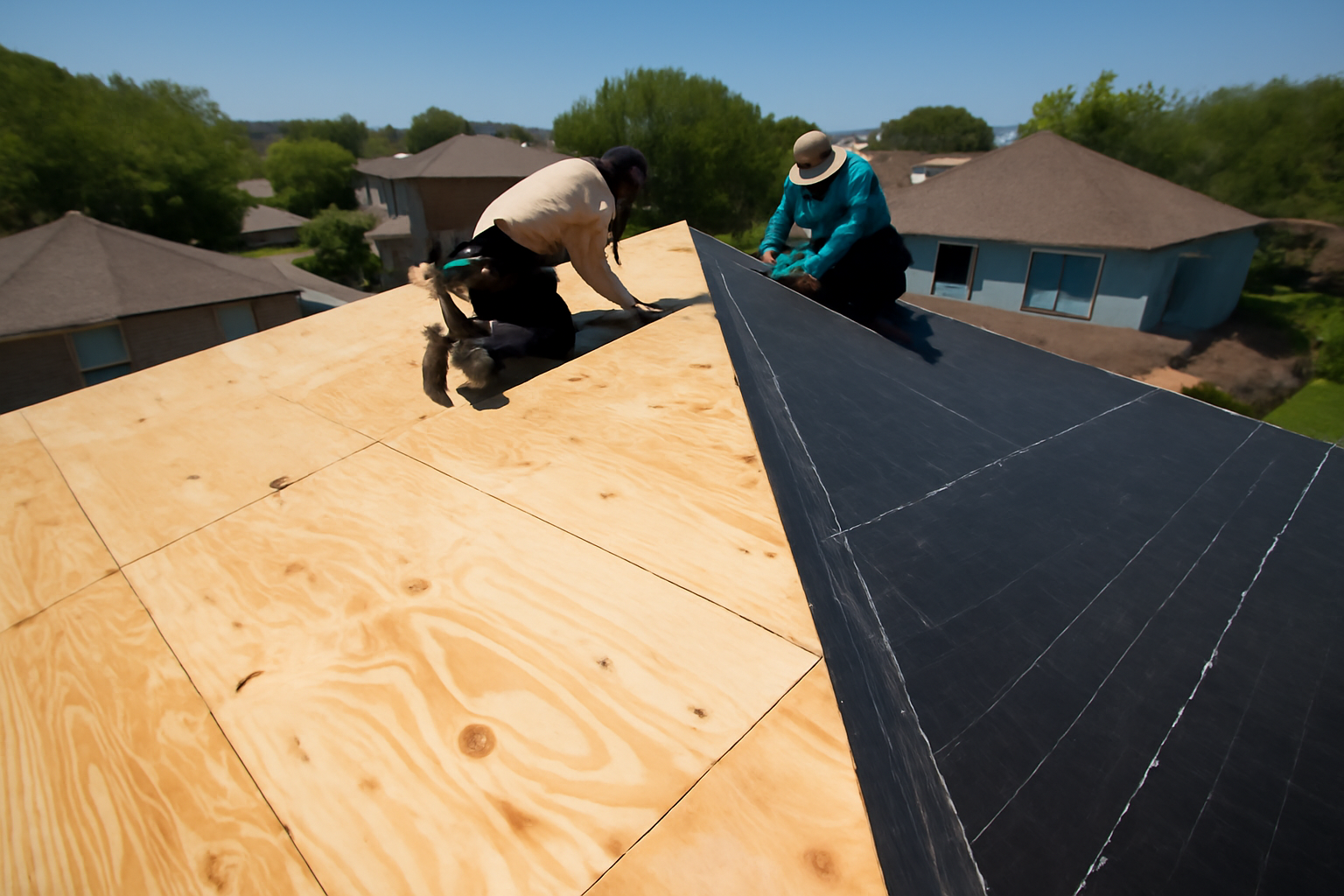
- Deck attachment upgrades. Older homes often have decking nailed with 6d nails in wider patterns. Current code typically requires 8d ring-shank nails at 6-inch spacing on edges. Re-nailing an entire deck adds real labor and material cost.
- Underlayment requirements. Homes built before 2009 often had 15-lb felt paper. Current standards lean toward synthetic underlayment or dual-layer applications in high-wind zones.
- Drip edge installation. Many older San Antonio roofs have no drip edge at all. Code now requires it on both eaves and rakes.
- Ventilation calculations. The 1:150 or 1:300 net free area ratio gets enforced during permitted re-roofs. If your attic ventilation is short, additional vents must be added.
- Flashing upgrades. Step flashing, kick-out diverters, and valley flashing methods have all been tightened in recent code cycles.
How Code Upgrade Coverage Works on a Claim
The process isn't automatic. Your contractor and your adjuster both play roles, and miscommunication between them is where most homeowners lose money.
Step 1: Identify the Code Gaps
During a free roof inspection, your contractor should document not just the storm damage but also any areas where the existing roof falls short of current code. This gets submitted as a separate line-item supplement to the insurance company — it's not lumped into the storm damage estimate.
Step 2: Verify Your Policy Includes O&L Coverage
Check your declarations page. Look for "Ordinance or Law" — it's usually listed as a percentage of your dwelling coverage (commonly 10%–25%). Some policies include a flat dollar amount. A few budget policies exclude it entirely. Carriers like USAA, State Farm, Allstate, and Amica typically include some level of O&L coverage on standard Texas homeowner policies, but the limits vary widely.
Step 3: Submit the Supplement Properly
This is where having an experienced contractor matters. The supplement needs to reference specific code sections — not just "code upgrade needed." We cite the exact IRC section, the municipality's adopted version, and provide photos showing the existing condition versus what's required. Adjusters approve these supplements far more often when the documentation is airtight.
What Code Upgrade Coverage Typically Pays For
On a typical San Antonio roof replacement through insurance, code upgrade coverage might add $1,500–$5,000 to the approved claim — money that goes directly toward making your new roof code-compliant. That's not padding; it's legitimate cost that the base claim estimate doesn't cover.
The three components of Ordinance or Law coverage are:
- Coverage A — Loss to the undamaged portion. If code requires tearing off parts of the structure that weren't damaged (e.g., removing an entire roof when only one slope was damaged, because partial re-roofs aren't code-compliant in some scenarios).
- Coverage B — Demolition cost. The cost to tear out components that must be removed to meet current code.
- Coverage C — Increased cost of construction. The actual cost difference between building to old code vs. current code. This is the big one for roofing — re-nailing decks, upgrading underlayment, adding drip edge, and improving ventilation.
Common Mistakes Homeowners Make
Not knowing the coverage exists. We've met homeowners who paid thousands out of pocket for code upgrades that their policy would have covered. They just never asked, and their contractor never supplemented for it.
Hiring a contractor who doesn't supplement. Some roofers — especially the storm-chasing crews that flood San Antonio after every hail event — just work off the original adjuster estimate and skip supplements entirely. They either cut corners on code compliance or leave you holding the bill.
Confusing code upgrades with "betterment." Betterment is when you voluntarily upgrade materials (say, from 3-tab shingles to architectural). Insurance doesn't cover that. Code upgrades are mandatory — you can't legally skip them on a permitted re-roof. That's why insurance covers them under O&L.
Should You Add More O&L Coverage?
If your home is older than 15 years and you're in a hail-prone area like San Antonio, Schertz, or New Braunfels, it's worth calling your agent and asking what your current O&L limit is. Increasing it from 10% to 25% of dwelling coverage usually costs very little — often under $50 per year — and can save you thousands when a claim happens.
Filing a Claim? Let Us Handle the Code Upgrade Supplement.
We document every code deficiency during our inspection and submit detailed supplements to your insurance company — citing specific code sections with photo evidence. That's money most contractors leave on the table. Schedule your free inspection and let us make sure your claim covers what it should.
Code upgrade coverage is one of those policy provisions that separates a frustrating insurance experience from a smooth one. The coverage is probably already on your policy. The question is whether your contractor knows how to activate it. If they're not talking about Ordinance or Law on day one, that's a red flag worth paying attention to.