EPDM vs TPO for Residential Additions | Wannamaker
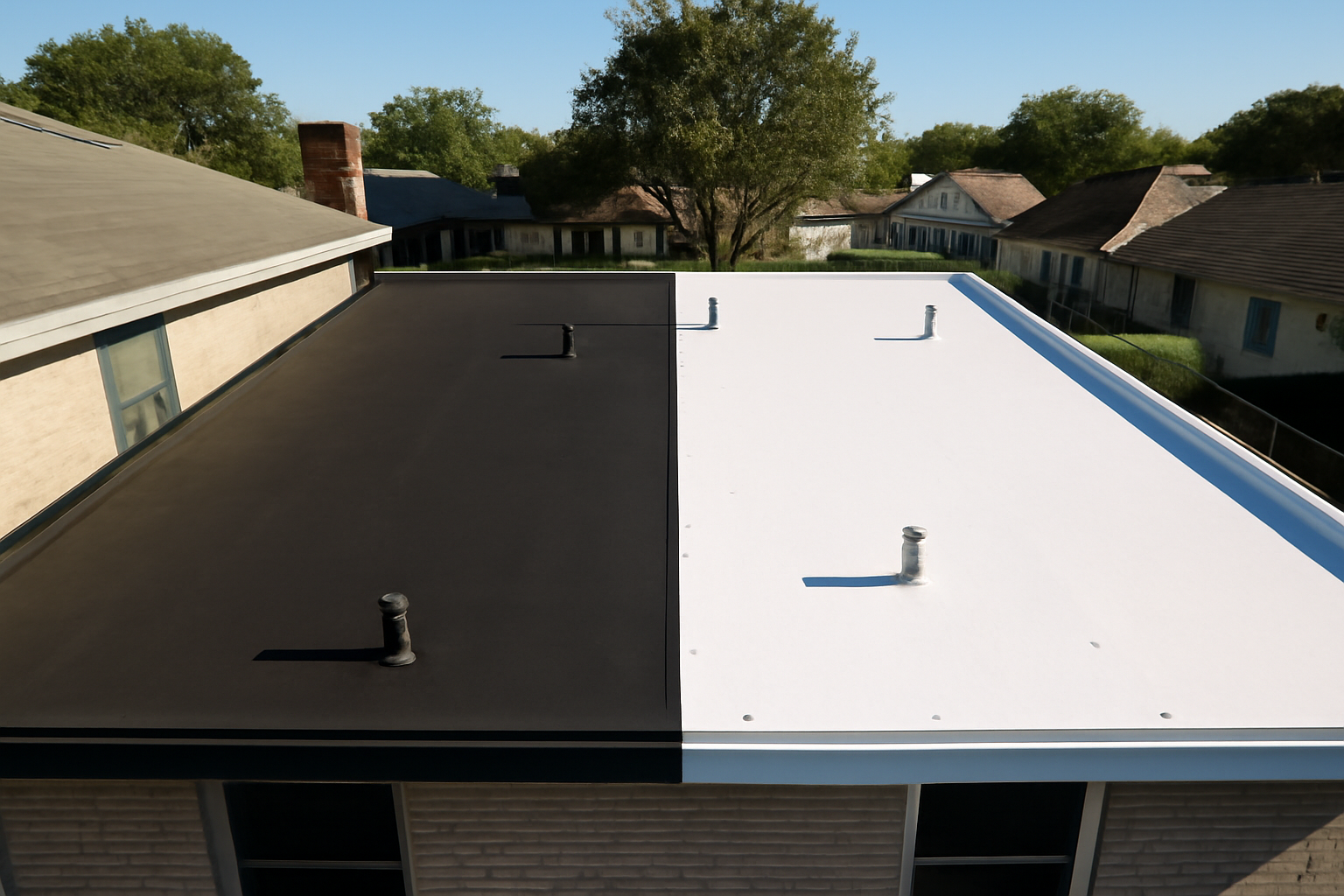
When a homeowner in Stone Oak or Alamo Heights adds a room, a covered patio, or a bump-out kitchen extension, the addition almost always ends up with a low slope — somewhere between ½:12 and 2:12. Standard asphalt shingles aren't rated for that pitch. So the real question becomes: EPDM or TPO? Both are single-ply membranes. Both are used on thousands of flat roofing projects every year. But they behave very differently in San Antonio's brutal UV and heat cycles, and picking the wrong one can cost you a decade of roof life.
What EPDM and TPO Actually Are
Let's skip the chemistry lecture and keep it practical.
- EPDM (Ethylene Propylene Diene Monomer). A synthetic rubber membrane. Usually black, though white versions exist. It's been on the market since the 1960s. Seams are bonded with adhesive or seam tape — no heat welding. Think of it as a giant, tough rubber sheet glued to your roof deck.
- TPO (Thermoplastic Polyolefin). A thermoplastic membrane, almost always white or light gray. Introduced in the 1990s. Seams are hot-air welded, which fuses the material together at the molecular level. Think of it as a heat-weldable plastic sheet with reinforcement fabric inside.
Heat Reflectivity: TPO Wins This One Decisively
San Antonio averages 30+ days above 100°F. A dark EPDM membrane on a low-slope addition absorbs most of that solar energy. Surface temperatures on black EPDM can hit 150–170°F on a July afternoon. That heat radiates into the room below, forcing your HVAC to work overtime.
White TPO reflects roughly 80–85% of solar radiation when it's new, and it typically maintains 70%+ reflectivity after a few years of weathering. On the same July day, a TPO surface might sit around 110–120°F. That's a meaningful difference for energy bills, especially on a sunroom or bonus room that may not have the same insulation depth as the main house.
Yes, white EPDM exists. But it costs more, it's harder to source locally, and it still doesn't reflect as well as TPO because the rubber compound absorbs more infrared wavelengths. If energy efficiency matters to you — and in this market it should — TPO has a clear edge.
Durability and Longevity: EPDM Has the Track Record
Here's where the conversation gets more nuanced. EPDM has a 60-year track record. We've torn off EPDM membranes that were 25–30 years old and still pliable. The rubber compound handles UV exposure, thermal cycling, and ozone degradation remarkably well over time.
TPO's track record is shorter — about 30 years of real-world data. Early TPO formulations (late '90s and early 2000s) had serious cracking and accelerated weathering problems. Manufacturers have reformulated multiple times since then. Current-generation TPO from major manufacturers like Carlisle, GAF, or Firestone is significantly better, but we simply don't have 30-year performance data on these newer formulations yet.
For a residential addition, a realistic lifespan expectation is:
- EPDM. 20–30 years with proper installation and maintenance.
- TPO. 15–25 years based on current formulations, though manufacturers warranty up to 30.
Seam Integrity: TPO's Biggest Advantage
This is the one that matters most in the field. EPDM seams are glued or taped. Over time, adhesive seams can lift, especially in climates with wide temperature swings — and San Antonio can swing 40–50°F in a single day during spring. Seam failure is the number-one cause of leaks on EPDM roofs. It's repairable, but it requires regular roof inspection to catch early.
TPO seams are hot-air welded. When done correctly, the welded seam is actually stronger than the field membrane itself. It's a permanent bond, not a glued joint. For a residential addition that might go years between inspections, this is a significant practical advantage.
Cost Comparison for San Antonio Residential Additions
Residential additions are typically small — 150 to 600 square feet. At that scale, material cost differences are modest. Labor and detailing around penetrations (vents, HVAC curbs, scupper drains) dominate the price.
- EPDM installed cost. Typically $5.50–$8.50 per square foot for a residential addition in the San Antonio market, including tear-off if needed, insulation board, membrane, and flashing details.
- TPO installed cost. Typically $6.50–$10.00 per square foot with similar scope. The premium comes from the welding equipment and the slightly higher material cost.
On a 300-square-foot addition, you're looking at roughly $300–$600 more for TPO over EPDM. For most homeowners, that difference is negligible when weighed against energy savings and seam longevity.
Repairability and Maintenance
EPDM is easier to patch. Any roofer with a can of EPDM primer and a rubber patch can make a solid roof repair. TPO repairs require a heat welder and someone trained to use it — not every handyman or general contractor has that equipment. If you're in a rural area outside San Antonio proper, this could affect how quickly you get emergency repairs done.
Both membranes are puncture-resistant, but EPDM's rubber flexibility gives it a slight edge against hail impact. After a hailstorm, EPDM tends to absorb the impact and bounce back, while TPO can crack if the membrane has aged and lost flexibility. If you're filing an insurance claim for hail damage, know that adjusters evaluate these two materials differently.
Our Honest Recommendation
For most residential additions in San Antonio, we lean toward TPO. The energy reflectivity alone justifies the modest cost premium in a market where summer cooling bills can double. The heat-welded seams give better long-term leak protection on a small roof section that homeowners tend to forget about. And current-generation TPO formulations have addressed most of the early durability concerns.
That said, EPDM is still a solid choice — particularly if the addition is shaded by the main roofline, if budget is extremely tight, or if you want the proven 30-year track record over the theoretical one. Neither material is wrong. The wrong choice is letting a contractor install whatever they have on their truck without discussing the trade-offs.
Planning a Low-Slope Addition?
We'll evaluate your addition's slope, drainage, and sun exposure — then recommend the right membrane with a written estimate. No pressure, no upsell. Schedule a free roof inspection and let's get your addition protected the right way from the start.